Lykkers, have you ever wondered if time can actually change? Imagine carrying a perfectly accurate clock as you travel toward one of the most extreme objects in the universe. To you, every second would seem completely normal.
Black holes provide the most dramatic environment for observing this phenomenon because their gravitational fields are extraordinarily intense.
Understanding why time slows near a black hole reveals not only how gravity works but also how space and time are woven together into the very fabric of the universe.
Gravity Does More Than Pull Objects
Most people think of gravity as the force that keeps planets in orbit or causes an apple to fall. According to general relativity, however, gravity is not simply a pulling force. Instead, massive objects distort spacetime—the four-dimensional combination of three dimensions of space and one dimension of time.
Imagine placing a heavy bowling ball on a stretched rubber sheet. The ball creates a depression, and smaller objects roll toward it. Although this analogy cannot fully represent four-dimensional spacetime, it illustrates how mass changes the geometry around it.
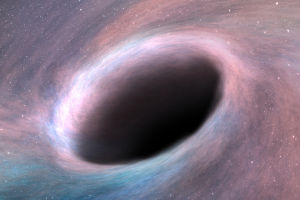
A black hole compresses an enormous amount of mass into an extremely compact region. The resulting curvature becomes so severe that even light cannot escape once it crosses the event horizon. Long before reaching that boundary, the distortion of spacetime already affects the rate at which time flows.
What Is Gravitational Time Dilation?
The slowing of time caused by gravity is known as gravitational time dilation. The stronger the gravitational field, the more slowly time passes relative to an observer located farther away from the source of gravity. This effect is not merely theoretical. It has been confirmed repeatedly through experiments involving highly precise atomic clocks.
Clocks placed at higher altitudes, where Earth's gravity is slightly weaker, tick marginally faster than identical clocks at sea level. Although the difference is tiny on Earth, it becomes enormous near objects with extreme gravity, such as neutron stars and black holes. Importantly, no one experiences their own time slowing.
If you were close to a black hole, your heartbeat, thoughts, and watch would all appear perfectly normal from your perspective. The difference only becomes apparent when comparing your clock with someone located much farther away.
Why Black Holes Produce the Strongest Time Effects
The defining feature of a black hole is its incredible density. Massive stars that exhaust their nuclear fuel can collapse under their own gravity, compressing matter into an extraordinarily small volume. As an observer approaches the event horizon—the boundary beyond which escape becomes impossible—the gravitational field grows dramatically stronger. To someone observing safely from a distance, the traveler's clock appears to slow continuously.
In theory, the traveler seems to approach the event horizon more and more slowly, never quite crossing it from the distant observer's viewpoint. Meanwhile, the traveler experiences no sudden pause in time and would cross the event horizon after a finite amount of personal time, assuming the black hole is sufficiently massive to avoid immediate tidal destruction.
Light Also Reveals the Passage of Time
Light provides another clue that time behaves differently near powerful gravity. As light escapes from the vicinity of a black hole, it loses energy while climbing out of the intense gravitational well. This process stretches its wavelength, shifting it toward the red end of the electromagnetic spectrum, a phenomenon known as gravitational redshift.
Because light carries information about events, the increasing delay and redshift together make processes near the black hole appear slower and dimmer to distant observers. The closer an object is to the event horizon, the more pronounced these effects become. Astronomers use gravitational redshift to study extremely compact celestial objects and to test predictions of general relativity with remarkable precision.
Real Technology Depends on This Principle
Although black holes provide the most dramatic examples, gravitational time dilation affects everyday technology much closer to home. Satellites in the Global Positioning System (GPS) orbit Earth where gravity is slightly weaker than on the surface. Their onboard atomic clocks naturally run faster because of gravitational time dilation while also being affected by their orbital speed.
Engineers must correct these timing differences continuously. Without applying corrections predicted by general relativity and special relativity, GPS positioning errors would accumulate rapidly, eventually producing navigation errors of several kilometers within a single day. This practical application demonstrates that time dilation is not merely an abstract scientific idea—it is an observable reality with direct consequences for modern society.
What Scientists Still Hope to Discover
Despite its extraordinary success, general relativity remains incomplete. At the center of a black hole lies a region called a singularity, where current mathematical descriptions predict infinite density. Under these conditions, general relativity no longer provides complete answers.
Physicists are working to reconcile general relativity with quantum mechanics, the theory governing the smallest particles. A successful theory of quantum gravity could explain what truly happens inside black holes and whether information is permanently lost or somehow preserved.
The idea that time slows near a black hole challenges one of our deepest everyday assumptions—that every clock in the universe must tick at the same rate. Modern physics has shown instead that gravity shapes not only the paths of planets and stars but also the flow of time itself. The next time you look up at the night sky, remember that somewhere in the universe, time may be unfolding at a completely different pace.