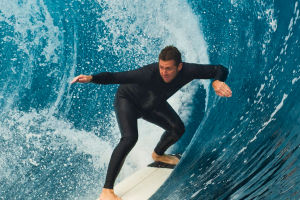
Surfing relies not only on physical strength but on coordination, balance, and proprioception. These qualities determine how effectively a surfer maintains control on an unstable and constantly changing surface.
From the shoreline, standing on a board may appear simple. In reality, the body is continuously responding to multi-directional movement. The board shifts forward, sideways, and vertically at the same time, while the wave itself constantly changes shape and speed.
The surfer’s nervous system processes this instability through continuous sensory input from the feet and lower body, producing rapid and subtle adjustments in posture and weight distribution. Performance depends on how efficiently these adjustments are made rather than on strength alone.
Dynamic Balance in Surfing
Balance in surfing is dynamic rather than static. It requires continuous adjustment of the body’s center of mass while moving across an unstable and shifting surface. Every turn, acceleration, and stance change involves rapid recalibration of posture in response to external forces.
Proprioception plays a central role in this process. It is the body’s ability to sense position, movement, and force through sensory receptors in muscles, joints, and connective tissues. Well-developed proprioception allows movements to occur with minimal conscious processing, enabling faster and more precise responses to changes in wave behavior. This ability distinguishes more experienced surfers from beginners, even when physical strength levels are similar.
Unstable Surface Training
Training on unstable surfaces helps replicate aspects of surfing’s physical demands. Such training challenges balance control, joint stability, and neuromuscular coordination.
Basic exercises involve maintaining a stable standing position under controlled instability. Progressions include controlled squats, directional weight shifts, and rotational movements that simulate turning mechanics. More advanced variations incorporate simultaneous tasks to increase cognitive and physical demand, improving the ability to maintain control under distraction.
Exercises performed on unstable platforms and soft training surfaces activate stabilizing muscles in the feet, ankles, hips, and core. These muscle groups are essential for making continuous micro-adjustments during movement on a wave.
Core Stability and Control
Core strength is essential for maintaining balance and control during surfing. The core functions as a link between the upper and lower body, allowing force to be transferred efficiently while maintaining stability.
A well-developed core enables smooth transitions between movements, while insufficient stability can result in delayed or inefficient responses to changing wave conditions. Training focused on controlled resistance, rotational movement, and anti-rotation stability improves the body’s ability to maintain alignment under dynamic load.
Movement-based core training emphasizes control, precision, and coordination rather than isolated muscle strength. Breath control and posture awareness further contribute to stability and movement efficiency.
Single-Leg Strength and Stability
Surfing places continuous demand on one leg at a time, as weight shifts frequently between front and back stances. This makes unilateral strength and control essential.
Single-leg exercises develop strength, balance, and stability independently in each leg while improving the ability to transfer weight smoothly between them. This supports key surfing movements such as directional turns, directional changes, and recovery from imbalance.
Training on unstable surfaces further enhances joint control and coordination, reinforcing the body’s ability to stabilize during rapid shifts in position.
Agility and Reactive Control
Surfing requires constant adaptation to unpredictable conditions. Changes in wave shape, speed, and surface quality demand immediate physical response.
Agility training develops the ability to move quickly and accurately in response to sudden changes. Drills involving directional steps, rapid foot placement, and controlled landings improve coordination and reaction speed.
These training methods enhance neuromuscular efficiency, allowing the body to respond more effectively to unexpected shifts in balance or direction.
Additional balance-focused practices that involve narrow or unstable surfaces further improve concentration, spatial awareness, and postural control under pressure.
Effective surfing performance is primarily determined by coordination, balance, and neuromuscular control rather than strength alone. Structured training that develops stability, proprioception, unilateral strength, and agility on land can significantly improve control and responsiveness in the water. The goal is to enhance the body’s ability to interpret and adapt to continuous instability with precision and efficiency.