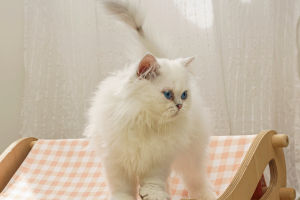
If you’ve ever seen a Ragdoll go limp in someone’s arms, you’ve already noticed the trait that made the breed iconic. Beneath that relaxed, almost boneless posture is a cat shaped by intentional breeding for gentleness and human connection.
Ragdolls aren’t simply calm and attractive—they display consistent behavioral patterns, unique physical structure, and a strong social nature. For those who know them well, these traits reveal a companion animal far more complex than its laid-back image suggests.
1. Ground-Level Comfort Isn’t Laziness—It’s Preference
Unlike agile climbers that dominate bookshelves and curtain rods, Ragdolls tend to stay close to the ground. This isn’t due to weakness or lack of ability. In fact, their bodies are strong and muscular beneath that soft coat. The difference lies in temperament.
Selective breeding emphasized calmness and reduced reactivity, which translates into less impulsive jumping and more deliberate movement. While many cats seek vertical territory for safety or dominance, Ragdolls often feel secure enough to relax in open spaces—living room floors, sofas, or directly across your feet. This grounded behavior is part of what makes them ideal indoor companions. They’re not uninterested in play, but their energy is expressed in shorter, more interactive bursts rather than acrobatic independence.
2. Their Coat Looks High-Maintenance—but Isn’t
At first glance, the Ragdoll’s semi-long fur suggests constant grooming sessions. Surprisingly, that’s not the case. Unlike many long-haired breeds, Ragdolls lack a dense undercoat. This single-layer structure dramatically reduces matting and tangling.
Their coat texture is often compared to rabbit fur—silky, fine, and smooth. Because of this, loose hairs shed more easily instead of clumping into knots. Weekly brushing is usually enough to maintain condition, though many owners brush more frequently simply because the cat enjoys the attention.
Coloration also follows a genetically defined “pointed” pattern, meaning cooler parts of the body—ears, face, paws, and tail—develop darker pigmentation. This is controlled by temperature-sensitive enzymes, a trait shared with breeds like the Siamese cat, but expressed in a softer, more blended palette.
3. They Respond to Training Better Than Most Cats
Ragdolls are often described as unusually cooperative, and that reputation is grounded in observable behavior. Their sociability makes them more receptive to human cues compared to typical independent-minded cats. Owners frequently report success with recall training—calling the cat by name and having it respond consistently.
Even more surprising, some Ragdolls learn to retrieve toys, mimicking the fetching behavior commonly associated with dogs. This isn’t accidental. The breed’s development prioritized docility and human bonding, which naturally increases trainability. They are not performing out of obedience in the canine sense, but rather from a desire to interact and remain engaged with their environment—especially when that environment includes their favorite person.
4. Their “Dog-Like” Reputation Has a Biological Basis
Calling a cat “dog-like” can sound like exaggeration, but in the case of the Ragdoll, it reflects consistent behavioral patterns. These cats form strong attachment bonds and often shadow their owners from room to room. This tendency is linked to low territorial aggression and high social tolerance. While many cats balance affection with independence, Ragdolls lean heavily toward companionship.
They prefer shared spaces, shared routines, and frequent interaction. They’re also more likely to greet people at the door, remain relaxed around visitors, and adapt to multi-pet households. However, this sociability comes with a trade-off: they don’t thrive in environments where they are left alone for long periods. Emotional engagement isn’t optional for this breed—it’s essential.
5. Their Size Is Often Underestimated
Ragdolls are among the largest domesticated cat breeds, yet their gentle nature often makes people forget just how big they are. Fully grown males can reach up to 9 kilograms (around 20 pounds), with long, rectangular bodies that stretch well beyond the average lap cat. Their slow development adds to the illusion.
Unlike most cats that reach full size within a year, the Ragdoll cat can take up to four years to fully mature. During this extended growth period, it slowly develops muscle and body length without ever looking heavy or stocky. Because of its size and thick coat, it’s often mistaken for the Maine Coon. However, the two breeds differ greatly in temperament and overall appearance. The Ragdoll carries itself with a gentler, more relaxed posture, giving it a calm, companion-focused presence rather than a rugged or wild impression.
The Ragdoll isn’t just a visually striking cat—it’s a carefully shaped companion animal designed for closeness. Every defining trait, from its relaxed posture to its social nature, reflects a breed that prioritizes interaction over independence.